
Predict and Prevent Paper Breaks Before They Happen
ProfitOps use Make AI Analyst to identify the root drivers of paper breaks, enabling targeted interventions that reduce downtime by 25%.
The Hidden Cost of Downtime
In pulp and paper manufacturing,
15–20% of total operating time is lost to unplanned disruptions costing millions annually in wasted fiber, energy, and capacity.

$2.4M
ANNUAL LOSS
per year (approx.)

17.7%
SHEET BREAK RATE
per year (approx.)

3,650
PRODUCTION HRS LOST
per year (average)
Four Forces Behind Every Sheet Break
Complex interactions between these four variables account for 90% of all unplanned production stops in modern paper mills.

Chemical Imbalances
Retention aid dosing, pH drift, and sizing chemistry fluctuations that weaken fiber bonding.

Water System Variability
White water consistency, drainage rates, and moisture content variations across the wire section.

Fiber Quality Shifts
Furnish composition changes, refining energy variations, and contamination from recycled content.

Drying Section Stress
Furnish composition changes, refining energy variations, and contamination from recycled content.
Variables Interaction Non-Linear Flow
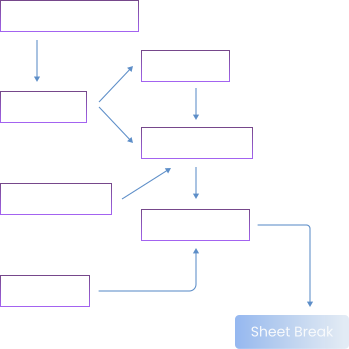
The Causal Chain: From Root Cause to Break
Understanding the sequence of events is key to prevention. ProfitOps traces the invisible path from minor deviation to major downtime.

The ProfitOps Difference
Traditional Approach
Reactive & Manual
Operators react after breaks occur
Root cause analysis takes days
Chemical dosing based on schedules, not conditions
Siloed data across DCS, QCS, and lab systems
Average 4-breaks per week
With ProfitOps
Predictive & Automated
AI detects drift patterns 2-4 hours before breaks
Automated root cause identification in minutes
Dynamic dosing recommendations based on real-time conditions
Unified data model across all process systems
Reduced to 1-break per week
$2.4M
ANNUAL SAVINGS
87%
SHEET BREAK RATE REDUCTION
< 6 weeks
TIME TO FULL ROI REALISATION
Ready to Eliminate Unplanned Downtime?
See how ProfitOps can identify your hidden production losses before they impact your bottom line.